Quick answer
Bromo ijen tour transport relies on a combination of private jeeps for summit access, shared shuttles or rented vehicles for intercity segments, and short motorbike transfers where roads narrow. Most visitors book a packaged multi-day tour with drivers included, though independent travelers can piece together legs using Malang-based rental agencies, terminal shuttles from Probolinggo, and local jeep cooperatives at Cemoro Lawang and Banyuwangi. The full circuit spans roughly 250 kilometers of mountain roads.
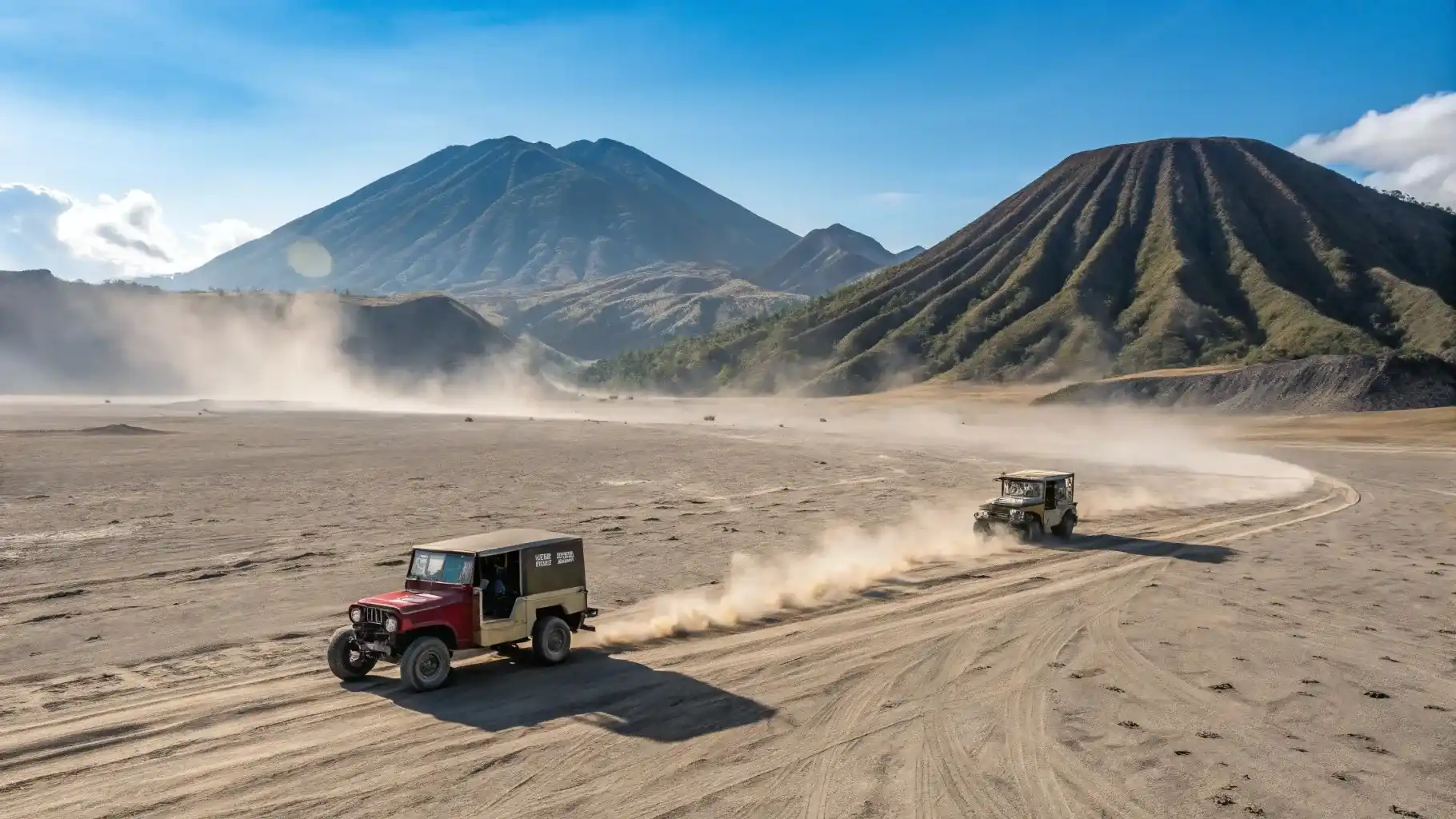
The road between Tumpak Sewu and Bromo's Cemoro Lawang village climbs 1,400 vertical meters over 85 kilometers, much of it single-lane asphalt threading rice terraces and pine forest. No public bus runs the route directly; most travelers hire a driver in Malang or Probolinggo, negotiate a rate that includes the detour to the waterfall, then continue to Bromo for the pre-dawn jeep convoy to Pananjakan viewpoint. Jeep hire at Cemoro Lawang operates through village cooperatives—expect to share the vehicle with other groups unless you book the entire cabin, which seats six. The Bromo-to-Ijen leg covers 140 kilometers and crosses two regencies. Shared minivans depart Probolinggo terminal mid-morning bound for Banyuwangi, though few stop at Cemoro Lawang itself; private vehicles offer door-to-door convenience and the flexibility to pause at Kalibaru coffee plantations en route. The road descends sharply past Jember, and the final 30 kilometers into Banyuwangi's Licin district are unlit after dusk. Ijen base camps sit another 12 kilometers uphill on gravel track—accessible only by motorbike or high-clearance vehicle. Transport for a bromo ijen tour involves booking three distinct segments unless you secure a unified package. Private drivers typically charge per day rather than per kilometer, and rates rise during Indonesian holiday weeks when demand outstrips vehicle supply. Rental cars without drivers are available in Malang and Surabaya, though few travelers attempt the mountain routes solo; road signage is sparse, fuel stations thin beyond district centers, and mobile reception drops for long stretches. Jeep cooperatives at both Bromo and Ijen enforce fixed pricing by departure hour—summit runs cost more than mid-morning transfers. Motorbike taxis bridge the last kilometers where sedans cannot reach: the steep descent to Tumpak Sewu's viewing platforms, the sand-sea crossing at Bromo when jeeps are full, and the final gravel push to Ijen's ranger post. Always confirm the return pickup time and location before setting off. Vehicle breakdowns on remote sections are rare but consequential—carry the driver's contact details and the local kepala desa number as backup. The transport backbone of the circuit is not a single mode but a sequence of vehicles matched to terrain, each leg negotiated separately unless bundled under a tour operator's umbrella.
“The transport backbone of the circuit is not a single mode but a sequence of vehicles matched to terrain, each leg negotiated separately unless bundled under a tour operator's umbrella.”
Navigating Bromo Ijen Tour Transport Routes
Connecting Tumpak Sewu, Bromo, and Ijen requires navigating rugged terrain across East Java. Private vehicle transport is the standard approach to manage the distances between these remote locations, typically starting from Surabaya or Malang.
Surabaya to Tumpak Sewu via Jl. Raya Malang-Lumajang
Tumpak Sewu to Bromo via Jl. Nasional III
Bromo to Ijen via Bondowoso/Situbondo route
Optimizing Your Bromo Ijen Tour Transport Itinerary
This three-day itinerary balances drive time with sunrise viewing opportunities, starting east and working west to minimize backtracking. The sequence prioritizes Ijen's pre-dawn blue flame before moving to Bromo's sunrise, then Tumpak Sewu's waterfall descent in daylight.
Arrive Banyuwangi, Transfer to Ijen Base
Land at Banyuwangi and drive 1.5 hours to a guesthouse near Paltuding. Rest early for the 01:00 departure to catch the blue flame.
Ijen Crater Hike and Blue Flame
Hike 1.5 hours uphill to the crater rim, descend to see miners and the sulfur flame, then return by sunrise. Drive 5–6 hours west to Bromo area after breakfast.
Transfer to Bromo, Settle at Cemoro Lawang
Arrive at Cemoro Lawang village by mid-afternoon. Arrange jeep departure for 03:30 the following morning and rest.
Bromo Sunrise Viewpoint and Crater Walk
Jeep to viewpoint for sunrise over the caldera, then descend to cross the sand sea and climb Bromo's crater stairs. Return to village by 08:00.
Drive to Tumpak Sewu, Descend Waterfall
Drive 2.5 hours south to Tumpak Sewu. Hike the steep trail to the base, allow 2–3 hours for the round trip, and depart before the 15:00 closure.
Best Time to Arrange Bromo Ijen Tour Transport
The dry season, spanning from April to October, offers the most stable conditions for navigating the roads between Tumpak Sewu, Bromo, and Ijen. Arranging your transport during these months minimizes the risk of weather-related delays and ensures more predictable travel times across East Java.
Dry Season (Apr–Oct)
Moderate to HighDry, 15°C–25°C; clear roads
Lower precipitation levels ensure safer transit and improved visibility for overland travel.
Wet Season (Nov–Mar)
LowFrequent rain, 20°C–30°C; muddy routes
Rainfall can cause road delays and unpredictable transit conditions through mountainous terrain.
Weekday Mornings
Low—
Departing early on weekdays helps bypass peak regional traffic between transit hubs and reduces total travel duration.
Verdict: The optimal period for travel is during the dry season from May to September, specifically planning movements during weekday mornings to avoid regional traffic congestion.
Entrance Fees for Tumpak Sewu and Bromo Ijen Tour Transport
Entrance fees for these sites are categorized as conservation fees or national park entry permits, which are separate from your transport arrangements. These costs are mandatory for all visitors and are paid at the respective site entrances.
A typical adult pays between 340,000 IDR and 490,000 IDR total for all three sites, with the final amount depending on whether the visit falls on a weekday or a weekend.
Official Opening Hours for Bromo Ijen Tour Transport Stops
The site remains open daily to accommodate visitors traveling through the Tumpak Sewu, Bromo, and Ijen corridor. Please align your travel schedule with these standard operating hours.
| Monday | 07:00–15:00 | |
|---|---|---|
| Tuesday | 07:00–15:00 | |
| Wednesday | 07:00–15:00 | |
| Thursday | 07:00–15:00 | |
| Friday | 07:00–15:00 | |
| Saturday | 07:00–15:00 | |
| Sunday | 07:00–15:00 |
Essential Preparation for Bromo Ijen Tour Transport
Multi-day volcano tours crossing East Java require advance bookings, valid ID for permits, and gear suited to high-altitude terrain.
-
Book your tour package in advance — Multi-day itineraries covering Tumpak Sewu, Bromo, and Ijen fill quickly, especially during peak season.
-
Bring your passport or national ID — Permits for Ijen Crater and national park entries require valid identification at checkpoints.
-
Pack warm layers and a windproof jacket — Pre-dawn volcano viewings at 2,300+ meters drop to near-freezing temperatures.
-
Wear sturdy hiking boots with ankle support — Volcanic ash, steep descents at Tumpak Sewu, and uneven crater trails demand reliable footwear.
-
Carry a headlamp with fresh batteries — Ijen's blue flame trek starts between 01:00–02:00 in complete darkness.
-
Prepare small bills for conservation fees — The 20,000 IDR entrance fee and occasional porter tips are cash-only transactions.
Check availability
Frequently asked questions about bromo ijen tour transport
Everything you need to know about bromo ijen tour transport